
San Diego County Parole vs Probation
Parole and probation are not the same record in San Diego County. Parole usually means supervision after a state prison term, with CDCR's Division of Adult Parole Operations handling many cases. Probation is a county court sentence or supervision term handled by San Diego County Probation. PRCS, or Postrelease Community Supervision, is a county probation track for some people released from state prison after realignment. Mandatory Supervision is tied to a split local sentence, where part of the term is served in county custody and the balance is served in the community.
The Sheriff also operates County Parole and Alternative Custody through CPAC. County Parole is a local early-release program for sentenced people in San Diego County custody, while Home Detention and Residential Reentry Center or Work Furlough may change where a sentence is served. Those options can make a person look "released" from a jail bed while the sentence and rules still continue.
| Supervision Type | Who Handles It | San Diego County Release Context |
|---|---|---|
| CDCR state parole | CDCR Division of Adult Parole Operations | Often follows a state prison release from Richard J. Donovan or another CDCR prison. |
| PRCS | San Diego County Probation | County supervision after certain state prison releases under realignment. |
| Mandatory Supervision | San Diego County Probation | Community portion of a split county jail sentence, often tied to Penal Code section 1170(h). |
| Formal probation | San Diego County Probation | Ordered by the court instead of, or after, a jail term. |
| County Parole | Sheriff CPAC | Local early release from custody for eligible sentenced people. |
- Discharge
- The end of a custody or supervision term after the agency closes the case.
- PRCS
- County probation supervision for some people released from state prison.
- Absconder
- A supervised person who is alleged to have stopped reporting or left supervision without approval.
- Detainer
- A hold or request from another agency that can affect release or transfer.
Verify San Diego County Supervision
A San Diego County release record answers one question: the person left a specific custody system. It does not always answer whether supervision remains. For a county jail case, the jail release may point to probation, CPAC, a court order, or no supervision. For a state prison case, CDCR, DAPO, BPH hearing records, PRCS, and the court sentence become more important than the Sheriff roster. Start with the record that matches the last agency that held the person.
- Identify the release source. Use the San Diego Sheriff record for county jail, CIRIS for CDCR state prison custody, or the court case for a sentence and probation order.
- Check whether the case is state parole, PRCS, mandatory supervision, formal probation, or County Parole. The labels sound close, but the offices differ.
- For state parole, use CDCR, BPH date and outcome pages, and the local DAPO office directory before assuming a county probation officer is assigned.
- For county probation, call San Diego County Probation Adult Records to find out where to report or how to contact the assigned officer.
- For County Parole or alternative custody, contact the Sheriff CPAC office because that program is local to the jail sentence.
When the live jail lookup no longer shows the person, use the custody release record and court case together. The San Diego County released inmates search path explains how the booking record, court case, and supervision record fit together after the roster drops a name.
Note: A released person can be out of jail but still under court, parole, PRCS, or CPAC rules.
San Diego County Supervision Offices
San Diego has more than one local supervision door. The CDCR Southern Region directory lists state parole units in Chula Vista and Escondido. San Diego County Probation handles adult community supervision, PRCS, mandatory supervision, and formal probation contacts. The Sheriff's CPAC program handles County Parole, Fire Camp, Home Detention, and Residential Reentry Center or Work Furlough. A call to the wrong office may not confirm the record, so match the office to the release type first.
The San Diego County Probation contact page lists Adult Records and local reporting offices used for probation supervision. The screenshot below shows that Probation maintains public office routing, which matters when a person released in San Diego County needs to report after custody.
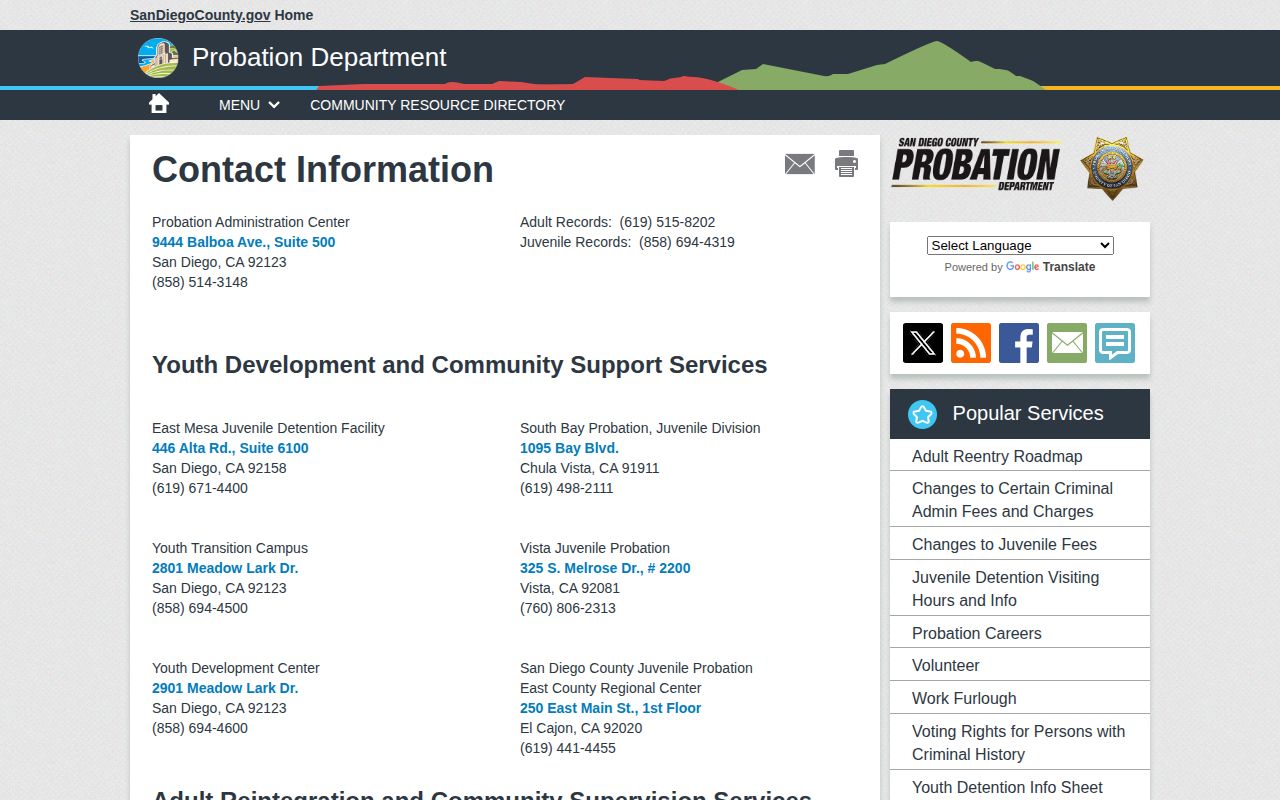
Use the office list as a routing tool, then confirm the actual case through the supervising agency, court record, or CDCR record.
Local Supervision Contacts
San Diego County Probation Adult Records
(619) 515-8202
Adult Reintegration and Community Supervision Services, Hall of Justice/Central Division
330 W. Broadway, San Diego, CA 92101
CDCR DAPO Chula Vista
765 Third Avenue, Suite 200 and Suite 300, Chula Vista, CA 91910
(619) 476-3700
CDCR DAPO Escondido
1301 Simpson Way, Escondido, CA 92029
(760) 737-7925
Sheriff CPAC
(858) 614-7650
CPAC@sdsheriff.org
San Diego County PRCS Reentry
San Diego's Community Transition Center is a distinctive PRCS pathway. The Probation Department describes the CTC and The Lighthouse residential treatment community in Loma Portal as a transition point for male and female people released from state prison to PRCS. The center is not a jail roster. It is a reporting and service location tied to county probation supervision after a state prison release.
The Community Transition Center page says a person can complete the 2-day or 48-hour reporting requirement, review release conditions, meet behavioral health staff, and connect with health coverage support. That detail is important for San Diego County parole and probation research because it shows why a state prison release may become a local Probation matter right away.
For PRCS, the release record should be reconciled with the CDCR record, the court sentence, and the county probation reporting instruction. If the person is not in CDCR custody anymore and has San Diego reporting duties, Adult Records or the CTC may be the practical verification point. If the person is on CDCR parole instead, DAPO is the better source.
San Diego County Parole Paths
County Parole in San Diego is local and should not be confused with CDCR state parole. The Sheriff's CPAC page describes County Parole as an early release from custody program for sentenced people who meet criteria. It also states that County Parole applicants must have served at least half their sentence before applying. Home Detention, Fire Camp, and Residential Reentry Center or Work Furlough can place a person outside a jail bed while the sentence is still active.
That distinction matters when reading a San Diego County release record. A person who leaves East Mesa Reentry Facility, George Bailey Detention Facility, or another Sheriff facility may be released to the community, transferred to another system, or moved into an alternative custody program. The release reason, court minutes, and CPAC record should be read together before treating the case as fully discharged.
| Program | What It Can Mean After Release |
|---|---|
| County Parole | Early release from local custody with program rules and an eligibility review. |
| Home Detention | Sentence service in the community, often with electronic monitoring. |
| Residential Reentry Center or Work Furlough | A structured custody alternative that can still be tied to the sentence. |
| Fire Camp | A CPAC alternative custody track for eligible sentenced people. |
San Diego County Violation Checks
Supervision conditions are the rules set by the court, CDCR parole authority, San Diego County Probation, or CPAC. They may cover reporting, location rules, treatment, testing, payment obligations, stay-away orders, or other case-specific terms. The public release record rarely lists every condition. It usually points to a supervising office, court order, or custody status that must be confirmed through the responsible agency.
An absconder or warrant status means the supervision agency or court may allege the person failed to report, left approved supervision, or violated a court order. Do not assume that every released person on parole or probation has a warrant. For state parole cases, CDCR/DAPO and law enforcement wanted-offender resources are the proper route if a wanted status is actually at issue. For county probation, San Diego County Probation and the Superior Court case are the better sources.
VINE can help with custody changes, not full supervision history. The San Diego Sheriff VINE page says users may register for notification when an inmate is released, pending release for sentenced inmates with scheduled dates, or transferred to another county facility or state prison. It is strongest before release or while the person remains in custody. After release, use the agency record to confirm supervision terms.
CDCR Hearings and San Diego Releases
Some San Diego County state-prison cases involve the California Board of Parole Hearings. BPH hearings are not county jail release hearings. They are state parole suitability or eligibility proceedings for people in CDCR custody, including cases that may be housed at Richard J. Donovan Correctional Facility in San Diego County. A person released later may report to DAPO Chula Vista, DAPO Escondido, or county PRCS depending on the sentence and release category.
The BPH hearing schedule is updated weekly on Thursday morning according to the research. BPH pages include hearing date, time, location, and whether the hearing is by video or in person when an in-person setting is needed for communication. The parole eligibility page also defines EPRD, MEPD, NPED, YPED, EPED, and controlling parole eligible date. Those labels can explain why a state-prison release date differs from a San Diego County jail date.
Note: A BPH parole date, a CDCR release date, and a San Diego County jail release date are separate records.
San Diego County Supervision Discharge
Supervision ends when the responsible agency closes or discharges the term, when the court modifies or terminates probation, or when the sentence structure reaches its legal end. The agency matters. CDCR or DAPO handles state parole discharge. San Diego County Probation handles local probation, PRCS, and mandatory supervision discharge. CPAC handles the local alternative custody or County Parole program record.
The California Public Records Act supports requests for nonexempt agency records, but it does not make every supervision file public. Sealed court records, juvenile records, medical details, victim information, law-enforcement investigatory material, and privacy exemptions can limit what is released. For a person trying to confirm that supervision ended, the best record is usually the court order, CDCR/DAPO status, Probation confirmation, or CPAC record rather than an old jail roster entry.
A final discharge does not rewrite the original jail release. It means the post-release obligation ended. Keep the records separate: release from custody, supervision assignment, violation history if any, and discharge from supervision.