
San Diego County Scheduled Release
A projected release date is an agency's current estimate, not a guarantee that the person will walk out at that exact time. San Diego County jail dates come from the Sheriff's booking system, sentence information, holds, and court orders. CDCR dates come from state sentence calculations and Board of Parole Hearings categories. Federal BOP dates are computed under federal law and can be recalculated. Each system can use its own label and its own update cycle.
Actual release is the event that has already happened. Scheduled, projected, tentative, eligible, and pending dates all point forward. The difference matters because a person may have a court date, a bail option, a local sentence, a CDCR eligible date, or a transfer hold. A public lookup date can change if credits are recalculated, a detainer appears, a court order is entered, or a parole decision changes the custody path.
Scheduled vs actual: San Diego County release dates shown online should be confirmed with the facility or records office because the Sheriff's lookup warns that release dates may be inaccurate during recalculation.
Find San Diego County Release Dates
The first step is to decide whether the person is in county jail, state prison, federal custody, immigration custody, or a court-supervised release path. San Diego County has seven Sheriff detention facilities, a city temporary holding facility in Chula Vista, CDCR's Richard J. Donovan Correctional Facility, federal detention, and ICE custody in the same county area. One search cannot compute all release dates.
- For a San Diego Sheriff jail case, search Who's In Jail while the person is still searchable, then save the booking number, facility, court case, and any displayed release date.
- If the person has dropped from the lookup, use the facility line at (619) 409-5000, Records & ID, and the Superior Court case to confirm whether release, transfer, or a data change occurred.
- For a CDCR state-prison case, search CIRIS by name or CDCR number and compare age, current location, and commitment county.
- For a parole eligible date, review CDCR and BPH labels such as EPRD, MEPD, NPED, YPED, EPED, and controlling parole eligible date.
- For a local jail sentence, use the court sentence, minute order, credits, holds, and Records & ID because the public roster is not a full sentence calculator.
The broader San Diego County released inmate search is useful when the issue is whether a person already left custody. A projected date question is narrower. It asks which agency is computing the date and whether that date is still current.
CDCR Dates for San Diego Releases
For a person sentenced to CDCR, the California Department of Corrections and Rehabilitation controls the prison release record. The CA.gov CIRIS service page says CIRIS includes name, CDCR number, age, current location, commitment counties, admission date, and Board of Parole Hearing dates and outcomes for incarcerated people currently in CDCR custody. A San Diego County jail record can show transfer out of Sheriff custody, but it does not compute the later prison release.
The CA.gov CIRIS service page documents the statewide fields available through California's incarcerated records search. The screenshot below shows the state service context for CIRIS, which is the proper state channel for CDCR release-date and parole-date research.
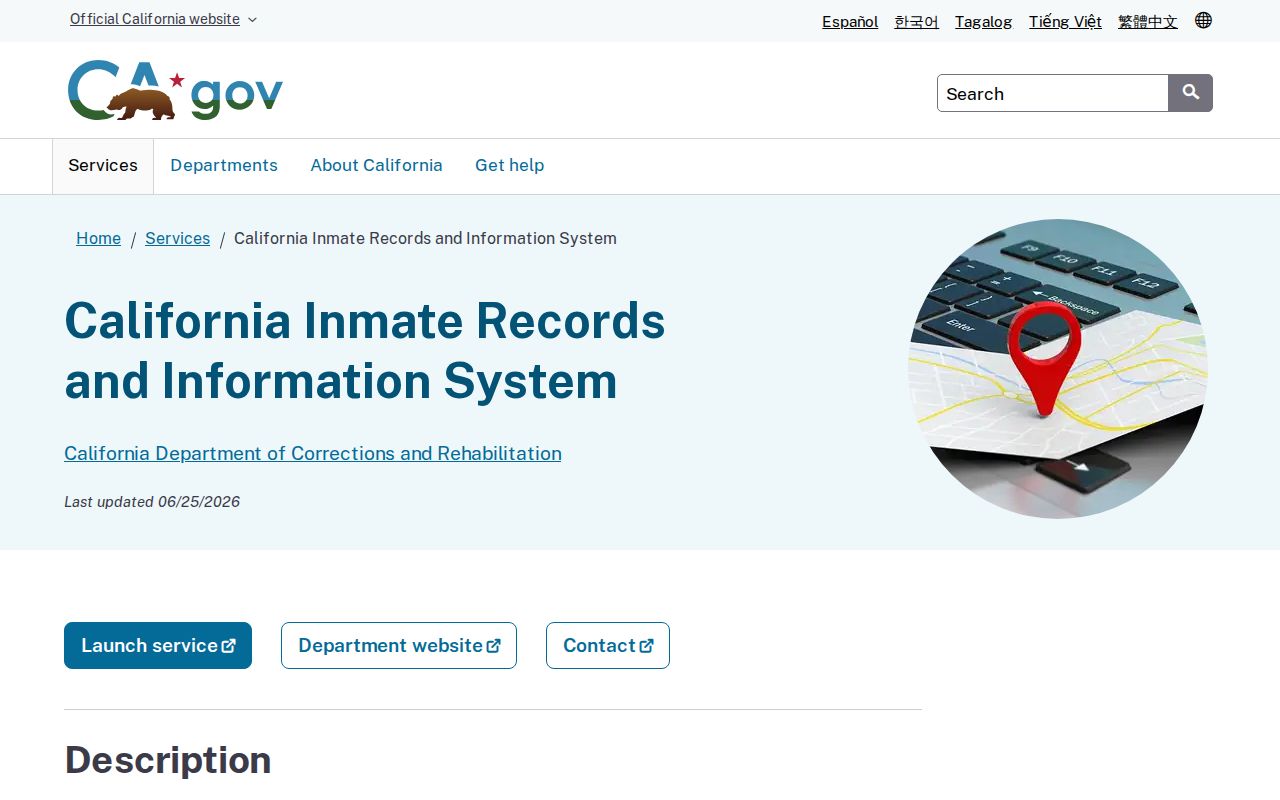
Use CIRIS for state custody context, then use BPH and DAPO records when the case involves parole eligibility, hearing dates, or state parole supervision.
| Date Label | What It Means |
|---|---|
| EPRD | Earliest Possible Release Date for determinately sentenced offenders, based on court sentence less applicable credits. |
| MEPD | Minimum Eligible Parole Date for people serving life with the possibility of parole. |
| NPED | Nonviolent Parole Eligible Date under Proposition 57 categories summarized by BPH. |
| YPED and EPED | Youth and elderly parole eligibility dates, when those categories apply. |
| Controlling parole eligible date | The earliest applicable chance for parole consideration or release when more than one date applies. |
San Diego County Good-Time Credits
California release-date math is statute-specific. Penal Code section 4019 governs many local custody conduct-credit calculations. It can affect a San Diego County jail projected release date after the court sentence, actual custody days, presentence credits, postsentence credits, and exclusions are applied. No public page should promise a release date without the minute order and sentence category.
Penal Code section 2933.1 is the violent-felony credit cap. It limits worktime or conduct credit for people convicted of specified violent felonies listed in Penal Code section 667.5(c) to no more than 15 percent. In plain terms, that is the California 85 percent issue for those cases. It does not mean every person in a California jail or prison serves 85 percent. Other offenses and sentence types can have different credit rules.
The California Legislative Information site is the official source for checking Penal Code sections that affect release-credit calculations. The screenshot below fits San Diego County projected release date research because jail credit rules must be tied back to the statute and sentence category.
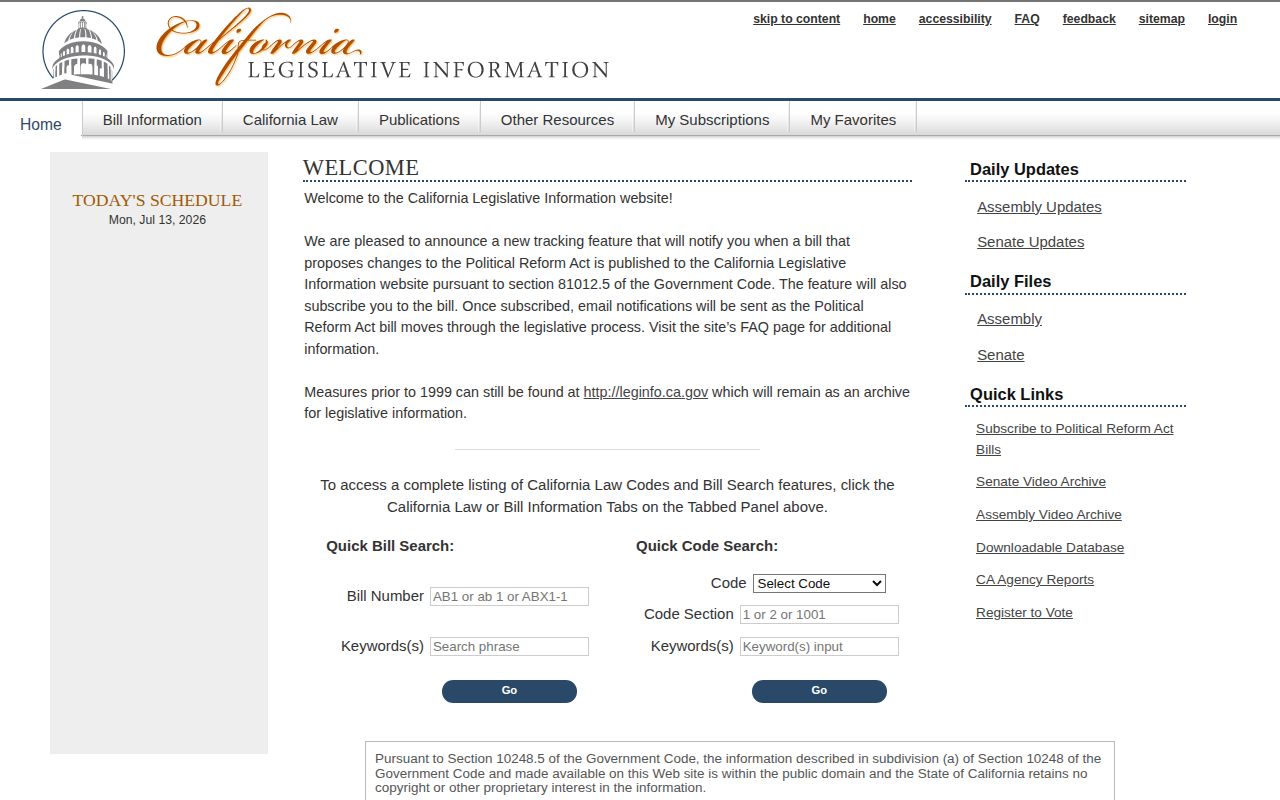
Use the statute source to identify the rule, then use the minute order, custody credits, and agency calculation to confirm the actual date.
Penal Code section 1170(h) also matters in San Diego County. Some felony terms are served in county jail after realignment, and some are split sentences with mandatory supervision in the community. A person can leave jail and still be serving the supervision portion. That makes the projected date, the release event, and the end of sentence three separate questions.
Good-time note: Use Penal Code sections 4019, 2933.1, and 1170(h) as starting points, then confirm the actual calculation through the court sentence and agency record.
San Diego Jail Date Warnings
San Diego's local jail lookup has an unusual release-date warning. The Sheriff's Who's In Jail page states that release dates currently reflected may not be accurate because numerous records are being recalculated and directs people to contact the facility for questions or confirmation. That warning should be treated as a core part of any San Diego County projected release date check.
For county jail cases, use the release date as a lead, not a final answer. Call the facility through the central custody information line if timing matters. Review the court case because a court order, bail change, plea, dismissal, sentence, warrant recall, or custody credit update may explain the release. If the person disappears from the lookup, that can mean release, transfer, a spelling mismatch, maintenance, or a data update.
Records & ID is the formal fallback for jail booking and release records. San Diego Sheriff's records information lists Records & ID at 9621 Ridgehaven Ct., San Diego, CA 92123, phone 858-974-2110, Monday through Friday from 8:00 a.m. to 4:30 p.m., closed from 12:00 p.m. to 1:00 p.m. and on weekends and holidays.
The court file is the other key record. San Diego Superior Court's online case search can show case title, case number, case location, case type, filing date, and parties. Those fields do not replace the jail record, but they identify the branch and file that may hold the minute order or disposition. Criminal case documents are not treated like simple online downloads in San Diego. The court's research material says they are available in person at the courthouse where the matter was heard or by mailed copy request.
Use that court path when the release date depends on bail, own-recognizance release, sentence completion, time served, probation, a warrant recall, or a transfer order. A jail record can show that the person left Sheriff's custody. The court record explains why the release happened and whether any later court date, probation term, or sentence balance remains.
Why San Diego Release Dates Change
A projected date can move for legal, sentence, custody, or data reasons. San Diego County has local jail releases, state prison releases, federal releases, and immigration transfers in the same region, so a date change should be traced to the agency that controls custody. Do not treat a change as proof of release until the actual record confirms it.
| Change Factor | How It Affects the Date | Where to Confirm |
|---|---|---|
| Credit recalculation | Conduct, worktime, or custody credits may adjust the scheduled date. | Court sentence, Sheriff Records & ID, CDCR case records |
| Detainer or hold | Another agency may delay release or cause transfer after local custody ends. | Facility, court case, receiving agency |
| Court order | Bail, dismissal, sentencing, warrant recall, or probation orders can change timing. | San Diego Superior Court Online Case Search |
| Parole decision | BPH or CDCR action may alter eligibility or release timing for state cases. | BPH schedule and CDCR records |
| CPAC placement | County Parole, Home Detention, or Work Furlough may move the person out of a jail bed while the sentence continues. | Sheriff CPAC and court record |
Note: A transfer date, a release-to-supervision date, and the end of the full sentence can be different dates.
San Diego County CPAC Dates
The Sheriff CPAC program adds a local release-date issue that does not exist in every county. The CPAC page says County Parole applicants must have served at least half their sentence before applying. CPAC also includes Home Detention, Fire Camp, and Residential Reentry Center or Work Furlough, which may involve electronic monitoring or a structured residential setting.
These programs can change where a person serves the remainder of a sentence. They do not always mean the criminal case is over. A San Diego County projected release date tied to CPAC should be checked against the court sentence, CPAC approval, reporting instructions, and any probation or mandatory supervision order. If the person was moved to a CPAC program, the release record should be read as a custody status change, not necessarily a full discharge.
Mandatory Supervision is another local date issue. San Diego County Probation's realignment material explains that mandatory supervision clients serve part of a split sentence in local custody and the remaining balance in the community under probation supervision. That means the jail release date may be earlier than the end of the full sentence. For San Diego County projected release date research, separate the jail exit date from the end of the supervision term.
Confirm San Diego County Release
VINE is useful when a release is pending or scheduled. San Diego's Sheriff VINE page says users can register for notification when an inmate is released, pending release for sentenced inmates with scheduled release dates, or transferred to another county facility or state prison. Registration should happen before release when possible because VINE is a notification system, not a complete historical archive.
Use the San Diego County VINELink check for a specific person when notification is the goal. Use Records & ID, the court case, CDCR, DAPO, Probation, BOP, or ICE when the issue is formal confirmation after the fact. For federal custody, the BOP Inmate Locator may show Released or Not in BOP Custody. For immigration custody, ICE's locator and facility contact control detention status.
A confirmed actual release should identify the agency, date, release reason, and whether another form of custody or supervision followed. Without those pieces, a projected date is only a clue.